Virtual to Reality

Virtual to Reality

Some great insights!

Hackathon Forum's avatarHackathon Forum

Should you be interested in Virtual Reality (VR), Augmented Reality (AR), Artificial Intelligence (AI), and many more, then we’ve got your back.

Several VR hackathons are being organised all around the world, to provide an environment for programmers, tech developers, UI/ UX designers, tech enthusiasts, professionals and students, to develop creative, innovative and disruptive solutions for immersive technologies.

Canberra VR, Leap MotionMicrosoft among others have organised various hackathons for VR and other mixed realities.

There is a whole list of VR hackathons coming up this year. Be on the look out, one might just be happening in your area.

View original post

Hackathon best practices

Hackathon best practices

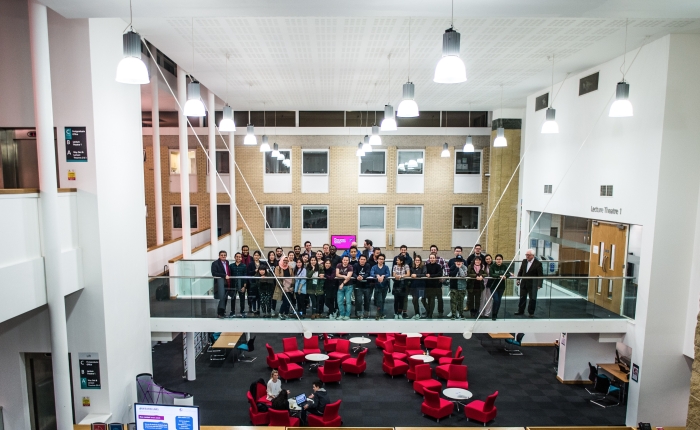
Last week I had the pleasure of participating into another hackathon, this time here at Lancaster University. Tasked with creating a concept to evolve the famous “Lake District National Park” here in the UK into a Smart Park using IoT, we spent two days in small groups imagining the future. With approximately 40 participants in total, the hackathon was a bit smaller than recommended, but the narrow topic balanced this aspect well.

Despite the short time, all teams were able to deliver exceptional results ranging from augmented reality adventure hunts, over “smart” cycle routes, to outdoor museums. But what was it that allowed this plethora of innovative ideas to emerge within this limited time? After reflection, I can share here some of the best practices for future events.

  1. Have a concrete problem: As mentioned, again and again, be concise when defining the problem the participants set out to solve. These guidelines will help to fully focus all the efforts on a goal. However, be always careful to only give the problem and not to restrict the possible solution too much.
  2. Have industry experts: As the participants push into unexplored territories they will need all the help they get to ask questions and to clarify the possibilities. Have experts from different areas to support the participants on every step
  3. Remove obstacles: For us, rooms, food, guidance was provided. This allowed again to fully focus on the problem at hand. This best practice sounds logical, but really take your time to go through the whole process when planning and see where obstacles might arise. A good example is a centralized food catering. Even though it sounds like a good idea at first, if it is limited to a certain timeframe it might significantly disrupt the workflow of certain teams and thereby impair their results.

Overall it was a great experience and the ideas kept flowing even after the hackathon was over. I am looking forward to my next experience.

Judges & Facilitators.jpg

What a happy Jury

Photo credits: “Creative Commons attribution and MSc. in E-Business and Innovation, Lancaster University Management School, 2017”

Do these three things to innovate

Do these three things to innovate

Innovation has become omnipresent. The media is full of new-tech idols, artificial intelligence, and 3D printing. For practitioners this exponentially increasing plethora of innovation is challenging and one might loose confidence in ones own possibility to be an innovator instead of a mere follower and adopter. However, following three steps can help you getting back into the game.

  1. Think of alternatives: Keep an open Mindset and look around. Whenever you see something that does not seem to make sense the way it is, think how it could be done differently. It does at this point not matter if your solution is impossible. The moon landing was impossible at the time when J. F. Kennedy announced it and within a relatively short period, the historic first step for humanity was taken. Constantly exploring different alternative will give you the right mind to be open for innovative ideas.
  2. Acknowledge the 90% 10% rule: Studies show that only about 10% of all innovation happening is actually new and unprecedented. This means that 90% of innovation exited in another area and is simply adapted to a new sector or subject. To put this rule in practice you can simply imagine how a player from other sectors would solve your problem. How would McDonald’s sell your product? What would Apple change about your design? How would Netflix make revenue with your service?.
  3. Understand your Brain: Our brain constantly emits measurable brain waves. When we are interacting actively or when we are working we are usually in a beta wave state. These short and fast waves allow us to think quickly and responsive. When we fall down to rest or into deep learning we slow down to an alpha wave state. However, it has been found that the most creative state is even one level below in the theta state. This can be experienced after waking up while being in a drowsy semi-state while meditating, or while being in a very relaxing shower. For you as an individual this means that it is often useful to slow down and relax deeply, taking a nap, or to meditate to connect the dots of the problem you are trying to solve and to thereby come up with the needed ideas.

These three rules are easy to explain but of course hard to follow. Building new routines and prompt yourself to keep active. I usually use small reminders, like a blank post-it on my desk or a small drawn point on my hand to remind me to look for alternatives or to slow down, pause, and the go again every here and there.

Thank you for reading. As always I am looking forward to your feedback and questions. Until soon, cheers.

image

Sizing your Hackathon

Sizing your Hackathon

Once you have defined the key problem the participants of your Hackathon set out to solve you have to start thinking about the size. If it is too small, your event might lack participants with capabilities and ideas that are key to solve the problem. If the Hackathon becomes to big, complexity increases, good ideas might not be heard and costs surge. However, what might the right size be?

In general the sizing is dependant on two variables. The scale of the problem on one hand, and the available resources on the other. Let’s first have a look at the scale of your problem that should be solved by the Hackathon participants.

  1. Narrow Problem: You have defined a very specific area in which the innovation can happen and provided a clear scope of the solution. E.g. in FinTech there are multiple events happening, focusing specifically on innovating the insurance branch of certain companies. Narrow problem events require usually a smaller number of participants with highly specialised knowledge in the area. A good mix of outside and inside experts will be sufficient to achieve the level of innovation expected. Concrete, we would speak about 50-250 participants
  2. Mid-scope Problems: When tackling problems that impact a region or broader industry you will need a wider audience participating in your Hackathon. An example would be the MedHack at the Johns Hopkins University, showing a focus on a the health sector but not on a specific region. A Hackathon of this scale will require multiple experts from several disciplines as well as outsiders to spark new ideas. Concrete, from 200-1000 participants should be participating
  3. Broad Problem: If the problem is not clearer defined in sector or region it is considered broad. Tackling global issues such as global warming or Human rights would be in this category. A good example is Hack the North in Canada with no concrete definition but more of a general theme. Experts from all possible areas are required to exchange to be able to tackle these problems. A Hackathon of this magnitude could span anywhere from 500-10’000 people or more.

Of course, all depends on the resources available. Not every institution can run a Hackathon with 10’000 participants. This implies that it might be necessary to narrow the problem to a solvable scope.

Whatever the size is, make sure to have a divers and interdisciplinary crowd participating, but also a structure in place to capture innovation as it happens to ensure the best possible outcome.

Thank you for reading. As always I am looking forward to your feedback and questions. Until soon, cheers.

image

The Hackathon on the Rise

The Hackathon on the Rise

When you study Business anywhere in the world, you will inevitably hear of the young and aspiring cult of entrepreneurs. Founders, such as Richard Branson, Mark Zuckerberg, Jeff Bezos and much more became the icons of our current generation. Instead of securing a job and a stable income, many of self-acclaimed young entrepreneurs strive for the next big thing. The next Facebook or Snapchat. The next Unicorn.

This quest creates an insatiable hunger for innovation. Therefore, it is not surprising to see that tools which promise to create innovation are on the rise. According to Google Trends, the interest for the term “Hackathon” has increased by 800% within the last five years.

screenshot-2017-02-11-14-28-03 The search interest over time for the term “Hackathon” worldwide (until February 2017)

This impressive rise in interest shows how much innovation is in demand. It is not surprising that even big organisations such as Facebook and Harvard (HackHarvard) use Hackathons nowadays to come up with new and innovative ideas.

A Hackathon lets you create the optimal context for disruptive innovation to happen. Assembling a diverse group of people, define a concrete problem to be solved, and put in several hours and days of work, until you have a solution. It is hard work and you will not create a unicorn in three days but it is a good start for everyone looking for the next big thing.

Only a few of the young entrepreneurs will ever make it to the top. The rest will eventually give up and accept that their billion dollar idea was not such a great innovation after all. Or that it is simply not doable. But you can as well try to set the context right and increase your chances. Follow this blog to see over the next weeks how to do it.

Hackathon at Facebook

Hackathon at Facebook

A great article written on the “Hackathon Forum” about the Hackathon practice at Facebook! Really worth reading!

Hackathon Forum's avatarHackathon Forum

Hackathons are now regular events at Facebook. The company has successfully integrated the events to become a tradition which occurs every other month. Every now and then, the company’s employees explore new ideas, while competing in a relaxed atmosphere.You know what? Majority of the features on Facebook actually came during the previous editions of the hackathons. Facebook live and the developer platform are vivid examples.

One of the events conducted at the Facebook HQ in 2016 featured a host of novel prototypes.

The Oculus fire nice team comprises a set of mechanical engineers who built a radiant heating system into a game console. When an avatar is in a cold region, the console gets cold, and does the opposite in a warm location.

Another team improved on the current safety check features on Facebook. You could request your friend’s location via the messenger app, and the app automatically grants such request (if the option…

View original post 58 more words

You should read these books about innovation

You should read these books about innovation

In this short post I will give an overview over the five best books you should read when going deeper into the topic of innovation:

  1.  The Innovator’s Dilemma (Management of Innovation and Change)
  2.  The Art Of Innovation: Lessons in Creativity from IDEO, America’s Leading Design Firm
  3.  The Lean Startup: How Constant Innovation Creates Radically Successful Businesses
  4.  Blue Ocean Strategy, Expanded Edition
  5. The Innovator’s DNA: Mastering the Five Skills of Disruptive Innovators  


You don’t have to know about innovation to be a great innovator, but it will certainly increase your chances to succeed. It is up to you.


Picture credits

How to make innovation happen in an artificial setting

How to make innovation happen in an artificial setting

When Sir Isaac Newton lay down under the apple tree at the Trinity College in Cambridge, he was struck by the idea that later developed into his theory of gravitation. Similarly, for most of us, it seems like the best ideas come to us when we are not actually looking for them. However, for an innovation hackathon to work, it is essential that innovation can, in fact, happen in an artificial setting. If this is not the case, there would be no point in doing them.

If we go back to Sir Isaac Newton and dig deeper, we will quickly find, it took him a long time to actually formulate his theory. Even though it has been confirmed that the apple tree story actually happened, the innovation process involved hard work, reflecting together with others, and iterating on the idea multiple times. It is this process that translates a simple idea into an actual innovation.

Most of the most successful ideas didn’t start with the actual intent to create innovation but with a very interesting problem. A problem grave and important enough to engage people into pursuing possible solutions. Within this heated exchange, creative ideas are most likely to emerge.

In short, you need a problem to be solved, people to do the solving, and a lot of hard work to create innovation. To me, this sounds exactly like the description of a hackathon.

If you want to know more about how to become an innovative thinker yourself, check out these two books:

Hackathons and why you should participate

Hackathons and why you should participate

Technology has become one of the cornerstones of our modern world. For most people in the west, a life without internet access and mobile phones would be unthinkable.

Looking at the current trends in computer science and technology, ranging from artificial intelligence, the blockchain, quantum computing, to self-driving cars and drones, and much more, show that we have only just begun to explore the possibilities. However, to keep up the fast pace of development we have to change the way we think and especially the way we work. A new set of methods and processes is needed to endure and thrive in this time. The almost all present lean software development method, replacing older legacy methods serves as a brilliant example of such a shift in methods.

The hackathon is a so far often overlooked new method, which, if used correctly, can yield extraordinary results for a company or a team. A hackathon is broadly spoken, an event where a large group of people collaborates for a defined time period, to solve a problem through a digital solution. It is comparable with a sprint for Software development or design but differs due to its participants and time frame. A typical hackathon will last from one to four days, to allow an intense problem-solving process to occur. The number of participants can range from a few dozens to a couple of hundreds, depending on the topic.

As a plethora of diverse experts and specialists join to solve a shared problem, the hackathon allows a steep learning curve for its participants. Iterating and learning together is part of the magic of such an event.

The ultimate result of a hackathon is usually code. However, many companies start to use the methodology also for other topic areas. Therefore, in this blog, we will talk about a hackathon centering about creating and pushing innovation. If you are planing a hackathon by yourself or if you are genuinely interested in the topic, follow along as over the next weeks I will share how an ideal innovation hackathon should be structured. If you haven’t already, join the next hackathon in your area and experience the fast learning and development. You won’t regret it.